



Article originally published on inquilabileninist.substack.com
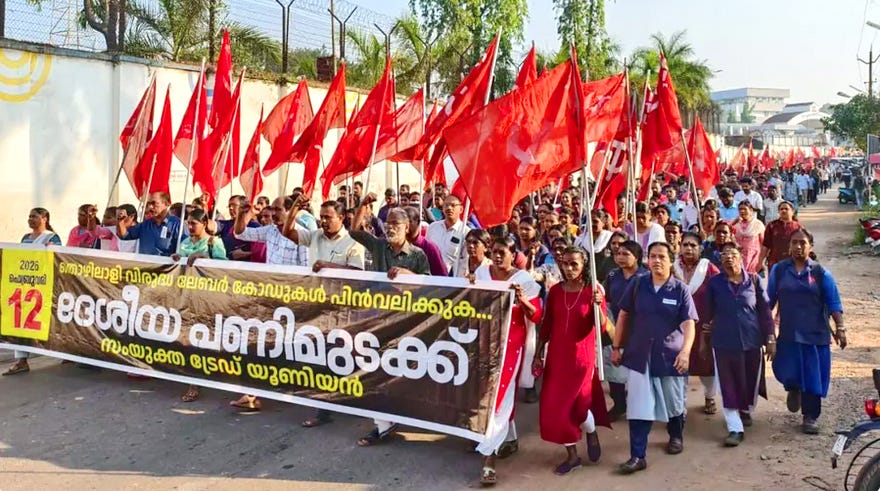
Last Thursday, Feb the 12th, tens of millions of workers and farmers heeded the call for a nationwide strike, delivering a powerful rebuke to the far-right BJP government’s unrelenting class war. The strike witnessed substantial participation from organised and unorganised sectors, public and private enterprises, multinational companies, scheme workers and rural toilers. Reports indicate that millions actively participated in demonstrations, picketing, and other direct strike actions.
The nationwide upsurge organised by Central Trade Unions, including CITU, INTUC, AITUC, and SKM (United Farmers’ Front), was a defiant response to a raft of anti-worker and anti-farmer measures: the implementation of the four draconian Labour Codes, the effective scrapping of the MNREGA rural employment scheme, the anti-worker and pro-corporate Union Budget for 2026-27, and the latest US-India trade deal, which threatens to devastate Indian farmers and small industry.
The sheer scale of participation—with millions walking off the job—is undeniable proof of deep-seated social anger and a willingness to fight. The strike brought vast swathes of the public sector to a halt and resonated powerfully in many regions, representing a significant, if uneven, expression of working-class power. However, any serious assessment must look beyond the inflated claims of the union bureaucracy to understand both the true extent of the strike and the profound political contradictions that limited its potential.
The Strike’s Strengths: A Sectoral and Regional Overview
The strike’s impact was most deeply felt in the public sector and in states where working-class consciousness and organisation have deep historical roots:
- Public Sector at a Standstill: Operations at key state-owned enterprises were severely disrupted. Coal India Ltd reported substantial participation, while iron ore, bauxite, and manganese mines in several regions saw major walkouts. The energy sector was hit hard, with near-total shutdowns reported in units across Himachal Pradesh, Kerala, and Maharashtra, also disrupting Power Grid Corp operations in the Northeast and South. Public sector banking, insurance (LIC, GIC), and steel plants like Rourkela saw branches closed or operations partially halted, with employees participating in large numbers.
- Critical Infrastructure and Transport: Cargo handling was disrupted at major ports like Paradip, Kakinada, and Tuticorin, as well as at key facilities in Kerala. The strike resonated in the transport sector, with road transport workers in Punjab, Odisha, and Kerala keeping private buses, taxis, and goods carriers off the roads. This solidarity action was a crucial component of the “Bharat Bandh” call.
- Manufacturing and Industrial Action: While private sector participation was far from universal, significant walkouts did occur. Tamil Nadu’s industrial landscape saw stoppages or disruptions at plants including Apollo Tyres, Yamaha, and Samsung. In the Cochin Special Economic Zone (SEZ), approximately 200 factories were reportedly non-operational. In Karnataka, more than 150,000 industrial workers from over 2,600 factories, including Bosch, Toyota, and Volvo, participated, despite facing the hostile Congress government. Cement plants across multiple states and the jute industry in West Bengal also saw strong strike actions.
- The Rural-Urban Link: The strike successfully drew in layers of the rural poor and informal workers. Tens of thousands of Anganwadi, ASHA, and Mid-Day Meal workers mobilised in states like Bihar, Gujarat, Punjab, and West Bengal. Farmers, organised by the SKM, held rallies and blockades, linking their struggle against the US-India trade deal to the broader fight against the government’s imperialist and pro-corporate agenda.
The Strike’s Critical Weaknesses: An Uneven and Contained Action
Despite these significant mobilisations, a sober analysis reveals a strike that was far less potent than its organisers claim, and one that failed to shake the foundations of capitalist power. The union leadership’s boast of 300 million participants seems exaggerated and designed to obscure the action’s limitations. Credible on-the-ground reporting paints a different picture:
- No impact in key industrial hubs: The strike failed in two of India’s most crucial industrial concentrations: the Gurgaon-Manesar belt near Delhi and the Sriperumbudur–Oragadam corridor near Chennai. This exposes the weakness of the unions in the face of private sector intimidation and their own passivity.
- Little effect in major industrial states: BJP-ruled states like Gujarat, Uttar Pradesh, Karnataka, and West Bengal saw minimal disruption, with public transport, factories, and offices operating normally. In Karnataka, the Congress government actively repressed the strike, arresting over 125 supporters.
- Concentration in public sector and “Left” strongholds: The strike’s real power was concentrated in the public sector and states like Kerala and Odisha. In Kerala, the strike was nearly total—but this was the only state where CPI(M) leads the government.
- Division in union ranks: The strike was not a unified working-class action. Rival unions aligned with the ruling BJP, such as the NFITU and TUCC, actively boycotted the strike in the Delhi-NCR region and publicly supported the government’s labour codes.
The strike was organised around a set of six core demands:
1. Scrap the 4 Labour Codes
This is the central demand of the strike. The four labour codes—on wages, industrial relations, social security, and occupational safety—represent the most sweeping attack on workers’ rights in Indian history. They legalise the rampant casualisation of labour through contract work, raise the threshold for applying labour laws to factories, gut protections against layoffs, and severely restrict the fundamental right to strike. By effectively abolishing the 8-hour workday and undermining unions, the codes are designed to turn India into a vast, low-wage, disposable workforce for corporate profit.
2. Right to Work as Fundamental Right. Employee Guarantee to All. Scrap VB-GRAM(G) Act. Restore and Strengthen MNREGA.
This demand links the urban and rural struggles. The scrapping of MNREGA, which provided a meagre but critical lifeline for millions of rural poor, is a death sentence for entire communities, forcing mass migration into urban slums and further depressing industrial wages. The demand for its restoration, with 200 days of work at ₹600 per day, is a fight for survival. Furthermore, the call for a universal, legally enforceable right to work exposes the lie of “development” under capitalism, which can only guarantee employment at the expense of super-exploiting a vast reserve army of labour.
3. Repeal Vikshit Bharat Adhistan Bill, 2025.
This bill is the legislative framework for the ruling class’s vision of a “Developed India”—a vision built on the backs of workers and peasants. While the specifics of the bill are broad, it is understood by the unions as an enabling act that accelerates the privatization of every remaining public asset, further centralises power in the hands of the corporate-friendly executive, and steamrolls all democratic and environmental opposition to “development” projects. Repealing it means rejecting the corporate, imperialist model of development and asserting the right of the working people to determine the nation’s future.
4. Stop Privatisation of Electricity. Withdraw the Electricity (Amendment) Bill, 2025. No Prepaid Smart Meters.
Electricity is a basic necessity for life and production. The Electricity (Amendment) Bill aims to privatise the entire power sector, from distribution to generation, handing it over to corporations whose sole motive is profit, not public service. Prepaid smart meters allow corporations to disconnect power to the homes of the poor and working class while ensuring profits for shareholders. This demand is a fight to keep a vital resource under public, democratic control, accountable to the needs of the people, not the market.
5. Repeal the Seed Bill, 2025. Stop Criminalisation of Save and Preserve Seed. Save Biodiversity of Indigenous Varieties.
This is a battle against the final enclosure of the commons. The Seed Bill is designed to force farmers into dependency on multinational corporations like Bayer-Monsanto. Criminalising the age-old practice of saving and exchanging indigenous seeds, it makes farmers completely reliant on purchasing expensive, patented, often genetically modified seeds each year. This destroys biodiversity, drives farmers into debt, and hands control of the food chain over to imperialist agribusiness. Defending the right to save seeds is defending the very basis of national agricultural sovereignty and the livelihood of millions of peasants.
6. Scrap Shanti Act. Stop Privatisation of Nuclear Power in India. Protect India’s Sovereignty and Ensure Safety of Indians.
The Shanti Act is a legislative shield for nuclear power corporations. It severely limits liability in the event of a disaster, effectively giving private and foreign companies a free hand to operate with impunity. Pushing for nuclear privatisation means handing control of a technology with catastrophic potential—and massive strategic importance—over to corporations whose priority is cutting costs, not ensuring safety. This demand correctly links the fight for national sovereignty to the fight against imperialist penetration. The working class has no interest in seeing India’s strategic assets or public safety sold off to the highest foreign bidder.
The strike was a powerful testament to the fighting spirit of millions of Indian workers. Its program of demands correctly identifies the key fronts in the ruling class’s war on the working people. It successfully disrupted the public sector, mobilised key regions, and linked urban and rural struggles. However, its failure to take hold in major industrial hubs, the active repression by opposition parties, and the treacherous role of its Stalinist and Congress-affiliated leadership in containing the strike’s militancy reveal its fundamental limitations.
The task ahead is to build independent rank-and-file committees, grassroots unions, and forge a revolutionary party capable of leading the working class in a unified struggle. The goal cannot be to pressure one section of the ruling class to be “nicer,” but to build the power to overthrow the entire system of exploitation. Both BJP and Congress governments serve the same capitalist interests. The working class must prepare to fight them both, for a socialist India free from the grip of imperialism and its capitalist agents. Only a workers’ government, based on councils of workers and peasants and committed to a planned socialist economy, could genuinely scrap the anti-labour codes, guarantee the right to work, and place the nation’s resources under democratic control of the toiling masses.
Long Live the Unity of the Working Class!
Long Live Workers–Peasants Unity!
Inquilab Zindabad!