



By Lenn Viken
Since the beginning of this new year, we have been reminded again and again that we are living in the midst of a capitalist crisis and an imperialist hellscape. Now, Trump has openly put his next target on the world’s biggest island: Greenland.
In the weeks that ensued, the media remained littered with geopolitical reporting of an inter-Western conflict, a conflict between Europe and North America, and ultimately, a conflict between Denmark and the US. Politicians all over the Western world were horrified at the thought that the US would threaten to invade a fellow NATO member, and an EU member at that! However, in the midst of all of this geopolitical discourse, there is one crucial element that devastatingly gets lost: that the name of this island is not actually Greenland, but Kalaallit Nunaat, and that the people who live there, the Kalaallit, are the ones who should be at the centre of this discussion.
The myth of the “Nice Nordic Colonist”
The very name Greenland itself stems from one of the earliest attempts at colonising the island. Indeed, in the 10th century, when Norwegian Vikings set up their first settlements on Kalaallit Nunaat, they named it Greenland to entice Norse people from Norway and Iceland to join their colonies. Despite not consulting with the Inuit ancestors of the Kalaallit Indigenous peoples inhabiting the island, the Norse settlers officially recognised Kalaallit Nunaat as part of the Kingdom of Norway in 1261, and the island was officially colonised as a Norwegian overseas territory with a similar taxation status to other islands, like Iceland and the Faroe Islands.
The empire thickened when Norway went into union with Denmark and Sweden in 1397, and particularly in 1536, when Sweden left the union, Norway was put under Denmark, and the island officially became the property of the Danish Crown. In the meantime, on Kalaallit Nunaat, the Norse settler colonies had died out, and the Inuit Kalaallit had increased their trade with European nations such as the Netherlands. Inspired by a colonial European zeitgeist, a Christian “civilising” mission and a jealousy of the European countries who were benefiting from Kalaallit Nunaat’s resources, Denmark began a systematic colonisation of the island from the 1700s onwards.
There has long been a perception of the Nordic countries as “nice colonists”, whose annexation of Indigenous territories into their kingdom was a peaceful process that cannot be put in the same category as other European colonial atrocities. However, if we truly turn our gaze to Kalaallit Nunaat in the North American Arctic and Sápmi in the European Arctic, it becomes clear that the “Nice Nordic Coloniser” is nothing but a myth which lives on to justify the continued Nordic colonisation of Indigenous Arctic land for never-ending profit and resource extraction.
Indeed, Denmark’s centuries-long systematic colonisation of Kalaallit Nunaat had resource extraction, assimilation and colonial violence at its core. As Denmark was getting rich from the abundant natural resources of the island, the Kalaallit were undergoing the symbolic and physical violence of a colonial regime that viewed Kalaallit language, culture and people as uncivilised. Though Denmark did not install residential schools like Norway, Sweden and Finland did in Sápmi (or as they were used as tools of colonial assimilation and violence across North America), many Kalaallit recount Denmark obtaining similar results of Danifying many Kalaallit kids by sending them to school in Denmark and forcing them to forget their language and culture.
When Kalaallit Nunaat was “decolonised” and went from being a colony to becoming a part of Denmark in 1953, there was nothing “nice” about this process either. Indeed, the Kalaallit in Nuuk in 1952 were presented with a deal to get two seats in the Danish parliament, and set up their own local government under the Danish state, and thus finally have a say in decisions made about their land. However, what the Kalaallit were not told at the time was that this deal ruled out any option for full decolonisation of Kalaallit Nunaat, and any full independence of the Kalaallit. Even as the Kalaallit now have an expansion of self-governance since 2009 under the Danish crown, the legacy of this Danish colonial violence lives on today as Kalaallit continue to suffer through poverty, colonial trauma, and now being thrown around as a colonial negotiation piece in an imperialist game between global Western superpowers.
Intersectional violence at the heart of the Danish colonial regime
As with most situations of colonial violence, the harm done by the Danish empire in Kalaallit Nunaat had an intersectional impact. This became particularly clear last year when the Danish journal DR exposed the non-consensual contraception campaign in the 1960s and ’70s, where the Danish State operated IUDs (‘intrauterine devices’ that prevent them from becoming pregnant) into the bodies of Kalaallit women and girls down to the age of 13, without their own or their parents’ consent. Indeed, Danish doctors would come to schools and insert IUDs in the bodies of young school girls without giving them any briefing on what was happening, nor any opportunity to resist. Needless to say, this campaign was incredibly traumatic for everyone subject to it, and as is often the case with gendered and colonial violence, many women kept their experience of abuse secret for decades, thinking it only happened to them or to their class.
In addition to being a deep psychological violation, women describe the pain of this operation as excruciating. The IUD of the time was a lot bigger than it is today and was not meant for women and girls who had not already given birth. This often led to pain that lasted for months and even years, not to mention the lasting mental trauma. It is important to note as well that for the women and girls who were already survivors of sexual assault, this process was incredibly retraumatising. Though this campaign ended in the 1970s after Denmark received criticism from the UN, the women who got IUDs forcibly inserted still live with that trauma today, and many still express fear at approaching medical care even when they need it.
This so-called “IUD campaign” clearly shows that even after Kalaallit Nunaat was no longer a “colony” of Denmark, but part of the Kingdom, colonial rule and violence remained. The reasoning behind this horrifically violent colonial and misogynistic policy was to limit the number of children born on the island as they were “costing Denmark money”, and Denmark was concerned about children not being born in the Danish Christian ideal nuclear family model, but to single or unmarried women. Despite this reasoning, it is clear that eugenics and colonial racism was also at the heart of the Danish State’s actions.
This tactic of intersectional colonial violence is nothing new, but a staple in the colonial tool-kit of many empires. Notably, the US led a violent sterilisation campaign of Puerto Rican women throughout the 20th century. This type of campaign is particularly cruel as Indigenous women had been told for centuries to not stand up to the colonial power, and many women experienced not having any say against the Danish colonisers at all, let alone in this intimate violation. When the campaign was brought to the public last year, the Danish Prime Minister finally apologised to the Kalaallit women subject to this violence. Of course, this is way too little, way too late, and Denmark seemingly continues to think that Kalaallit Nunaat is their rightful land.
Indigenous resistance today
Trump has talked a lot about global security in his attempt to annex Kalaallit Nunaat. However, we know that the motivations for any colonial expansion are always the same: extractivist capitalism, and as usual in the US’s case, fossil fuel. This was clear in Venezuela and this is clear in Kalaallit Nunaat. Indeed, as the climate crisis worsens and the ice-caps on Kalaallit Nunaat rapidly melt, vast mineral and fossil fuel reserves are being exposed, including rare metal reserves. Any new deal that Trump has managed to negotiate with the European powers will include a heightened US presence on the island, not only in regards to military but also to big US extractivist companies.
Indigenous lands in the Arctic have long been subject to extractivist imperial expansion, and though new reserves are being exposed now, the US’s imperial interest in the island is nothing new. Indeed, ever since Manifest Destiny and the Monroe Doctrine in the 19th and 20th centuries, the US has made repeated attempts at expanding its territory to also reach Kalaallit Nunaat in a similar way to how it purchased/annexed Alaska and many Latin-American territories. With this long history, there is no reason to believe that this will be the US’s last attempt at annexing the island, and it is more important than ever that we stand in solidarity with the Kalaallit as they resist imperial attacks from extractivist countries and companies.
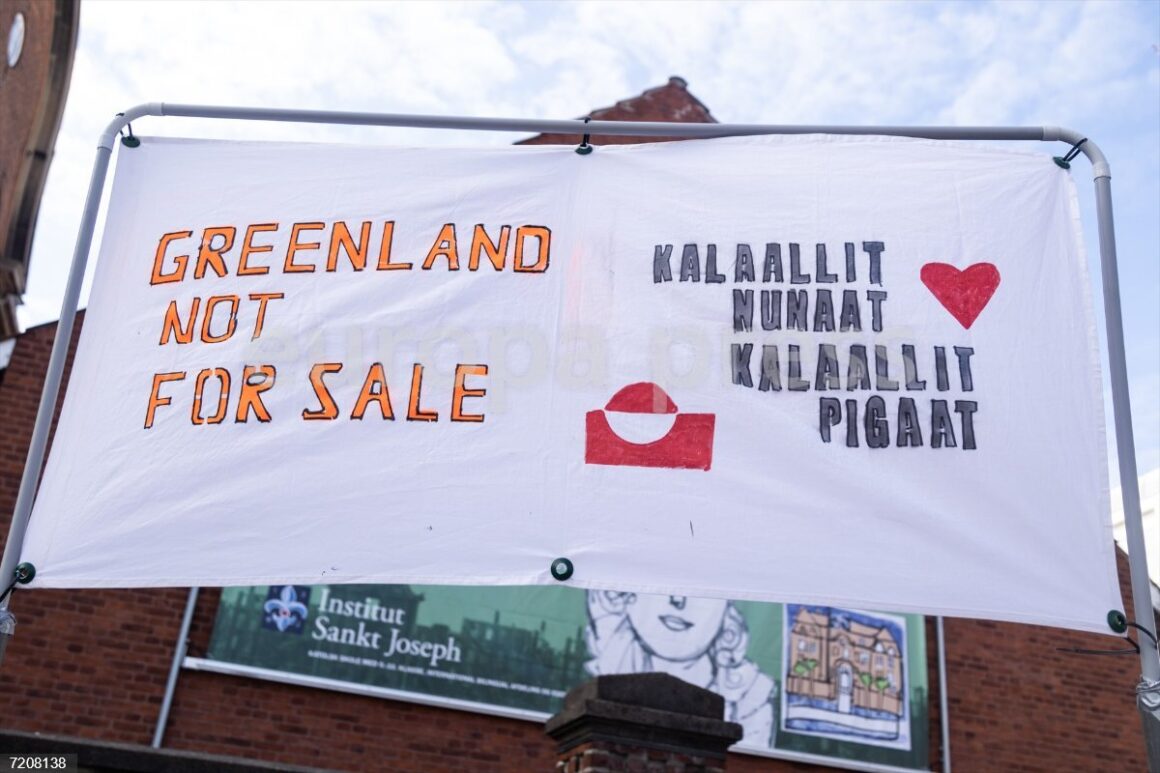
Last week, the biggest anti-US-imperialist protests to date took place in Kalaallit Nunaat as the capital city Nuuk was filled with shouts of “Kalaallit Nunaat, Kalaallit pigaat” and “Make America Go Away”. In these protests, the Kalaallit are rightfully demanding to be at the centre of negotiations that concern them and their land, and they are not alone in making this demand. The Inuit Circumpolar Council (ICC) has clearly stated that the Kalaallit Inuit need to have the space to reach agreements with various governments on their own terms and that the Inuit’s work for decolonisation has to happen through sincere and equal partnerships – not through supposedly benevolent invasions by another power-hungry US president. Moreover, the Sámi Council that represents Indigenous Sámi in Sápmi across Norway, Sweden, Finland and Russia, has expressed its solidarity and made a statement in complete support of the ICC on this matter. At the same time, Denmark seems intent on keeping their colonial hold on Greenland. In the West, there is still a widespread colonial perception of the Kalaallit as a people who are not strong enough to govern themselves. The former Danish Prime Minister made this abundantly clear when he recently told a Kalaallit activist that they were lucky to be governed by Denmark because they would not survive on their own, and they would not easily find another empire as “nice” as Denmark. However, as we know by now, the myth of the “Nice Nordic Colonist” is nothing but that – a myth.
Thus, if we, as a movement, are serious about anti-imperialism, anti-capitalism and socialist feminism, we need to centre Indigenous voices and support the Kalaallit in how they decide to organise their own movement toward decolonisation. We have to stop speaking about this as a geopolitical conflict between Denmark and the US and start speaking about it as a continuation of the long history of annexation of Indigenous land by Western superpowers to extract fossil fuels and minerals from ancestral territories that has led us to the climate crisis and the general state of the world today. We need to see that this is the same extractivist colonial process capitalism relies on to continue the facade of endless growth, while violently tapping sacred Indigenous land dry of the resources that Indigenous peoples have been guardians of for centuries. And ultimately, we need to decolonise our worldview and call the island by its name: Kalaallit Nunaat.